

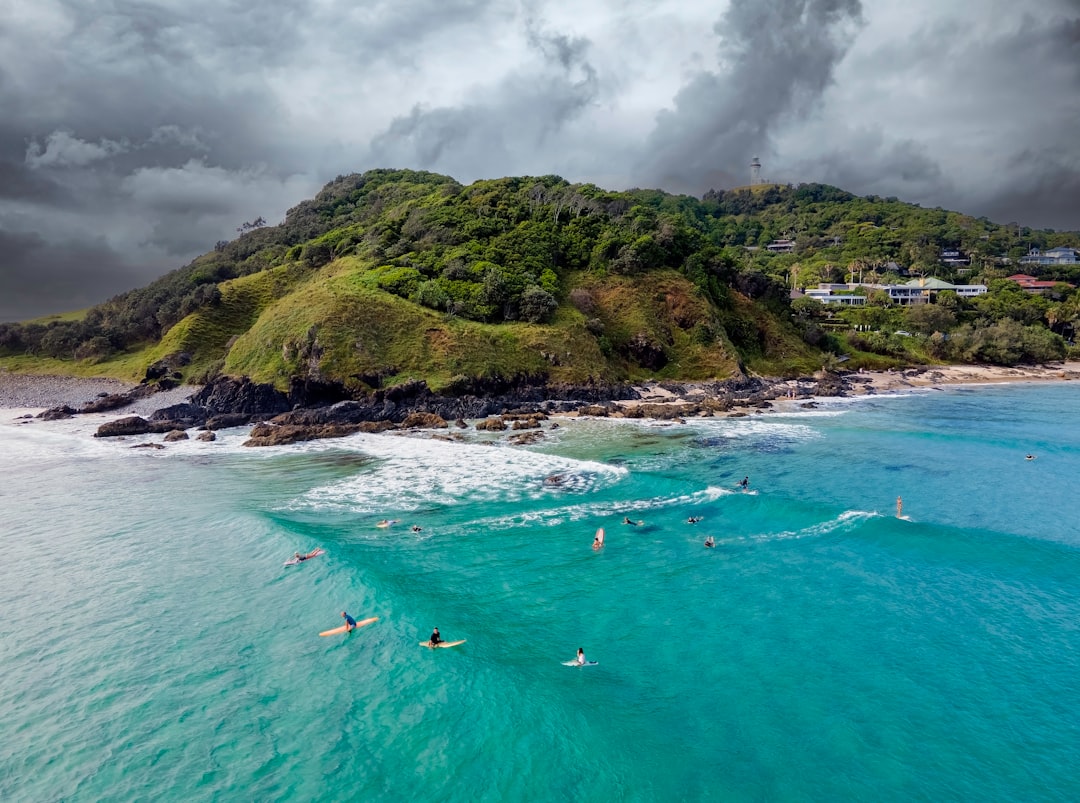


Standing at the edge of Wategos Beach, the pre-dawn light paints the sky in soft pastels of apricot and lavender, creating a stunning contrast against the jagged silhouettes of the Norfolk Pines lining the shore. In the distance, the Byron Bay Lighthouse stands sentinel on Cape Byron, the easternmost point of mainland Australia, watching over the rolling Pacific swell. As the first wave of the morning laps against your ankles, the temperature shock is immediate and bracing—a crisp, invigorating reminder that the ocean here is wild, untamed, and fundamentally different from a heated pool. This is the moment the country greets you, not with words, but with the physical reality of salt and sand. It is a sensory overload that defines the Australian outdoor experience, a place where the beauty of the scenery is matched only by the power of the elements.
The Anatomy of the Australian Coast (Reading the Water)
To truly swim in Australia, you must first learn to read the water. It is a skill that separates the casual tourist from the true ocean enthusiast. Many visitors approach the coastline with a “float and bob” mentality, expecting a benign aquatic playground. However, the East Coast, influenced by the vast Pacific Ocean and the complex currents of the Tasman Sea, is a dynamic system governed by physics and geography.
We spoke with Senior Lifeguard Jono, who has spent the last decade patrolling the very stretch of coast from Broken Head to Tallows Beach. He explains that understanding the ocean is about shifting your perspective from fear to curiosity.
“The ocean isn’t trying to kill you, but it is incredibly powerful. If you treat it like a machine, you can learn how it works. Most panic happens because people are surprised by the mechanics of a rip or a wave break. Once you understand the hydraulics, you stop fighting the water and start working with it.”
Decoding the Hydraulic Systems
The Australian beach is not a static basin; it is a conveyor belt of energy. To swim safely, you need to understand three distinct anatomical features:
- Rips (The Rivers of the Sea): These are narrow channels of water that flow back out to sea after the waves have pushed them up the beach. Contrary to popular belief, rips do not pull you under; they pull you out. They are identifiable by darker, deeper water, fewer breaking waves, and sometimes a rippled surface surrounded by calm water.
- Sandbars: These are submerged ridges of sand where waves break. The shape of the sandbar dictates the shape of the wave. In winter, storms often strip sand away, creating steep, gutted beaches. In summer, sand builds up to form gentle, sloping benches.
- Gutters: These are the deep channels formed between sandbars. For a swimmer, a gutter is the Holy Grail. It is a calm channel of water parallel to the shore where waves don’t break, allowing for a smooth, flat swim. If you want to swim laps at the beach, you swim in the gutter, not the breaking waves.
Understanding these elements transforms the coastline from a chaotic expanse of water into a readable map. In Byron Bay, the geography creates specific micro-environments. The Pass, for example, is protected by the headland, resulting in a long, sand-shifting point break that creates a gentle channel ideal for wading, whereas Main Beach can be exposed to the full force of the northerly swell, creating heavy shore breaks.
The Gradient of Ability: From Wading to Ocean Swimming
Swimming in Australia is not a “one size fits all” activity. The country offers a gradient of experiences that cater to absolute novices and elite endurance athletes alike. Rather than listing locations by popularity, it is more useful to categorise them by competency and the type of interaction they offer with the ocean.
The Shallow End: Sheltered Coves and Confidence Building
For families, young children, or those simply wanting to cool off without exertion, the goal is to find protection. You are looking for beaches that face south or are tucked behind headlands that block the dominant north-easterly swell.
Wategos Beach is the quintessential “Shallow End” location. Facing north and nestled under the Cape Byron headland, it acts as a natural harbour. The waves here typically roll gently, spilling over rather than dumping. It is the perfect venue for wading waist-deep and floating while watching the sunrise. The vibe here is communal and gentle; on any given morning in 2026, you will see locals floating on backs chatting, while children hunt for hermit crabs in the shallows.
Similarly, The Pass offers a sheltered lane near the rocks. While the surf break can get crowded, the inner corner provides a calm pool effect. It is an excellent spot to practise treading water and getting comfortable with the sensation of saltwater in your ears.
The Transition: Handling the “Washing Machine”
Intermediate swimmers are ready to engage with the energy of the ocean but may not yet have the fitness for long-distance endurance. This stage is about managing the impact zone—the area where waves break.
The Deep End: Ocean Swims and Endurance
For the expert, the ocean is a gym without walls. Ocean swimming involves traversing open water between landmarks, a practice popularised by the Byron Bay Winter Swim squad who brave the chill from May to September.
A classic “Deep End” route is the swim from The Pass to Wategos. This is not just a physical workout; it is a technical exercise requiring specific skills:
- Sighting: Unlike a pool, there are no black lines. You must lift your head every few strokes to orient yourself against the horizon or a landmark like the lighthouse. In choppy conditions, this strains the neck and requires core stability.
- Drafting: Experienced swimmers will position themselves slightly behind and to the side of another swimmer to reduce drag, much like cyclists in a peloton.
- Bilateral Breathing: Essential in open water to keep an eye on swell direction from both sides, ensuring you don’t get broadsided by a wave you didn’t see coming.
Invisible Hazards and Local Wildlife (The Honest Reality)
No guide to Australian swimming would be complete without an honest discussion about what lies beneath. While the risk of shark attack is statistically infinitesimally small (you are more likely to be injured driving to the beach), it is the invisible hazards that often ruin a swim day.
The Bluebottle Encounter
I recall a flawless morning at Clarkes Beach last January. The water was glassy, the temperature a balmy 26 degrees. Halfway through a swim, a sharp, electric burning sensation shot across my forearm. A bluebottle (Physalia physalis), trailing metres of invisible tentacles, had drifted into my path. The pain was immediate and visceral, a testament to the potency of even small marine stingers.
This encounter validates the fear that many hold about our waters. However, handling it is a matter of science, not myth. If you are stung:
- Do not rinse with fresh water: This can cause more nematocysts (stinging cells) to fire.
- Do not rub sand on it: An old wives’ tale that only aggravates the skin.
- Use hot water: Research indicates that immersing the area in water as hot as can be tolerated (around 45°C) effectively denatures the venom protein and provides immediate relief. Ice packs can also help if hot water isn’t available.
Honest Limitation: When NOT to Swim
True expertise is knowing when to stay on the sand. Even the most hardened locals will sit out days during the onset of a northeasterly sea breeze, known locally as a “Nor-Easter.” These winds chop the surface up, making swimming exhausting and visibility poor.
Furthermore, after heavy rains—which have been frequent this season—stormwater runoff can wash contaminants into the ocean. It is advisable to avoid swimming for at least 24 hours after heavy rain at ocean outfalls like Belongil Creek. It is a decision made out of respect for your own health, not fear.
The Stingray Shuffle
One of the most common injuries in shallow water is stepping on a stingray. These creatures are docile and generally only strike in self-defense when stepped on.
The “False Bottom” Discovery: I once stood waist-deep at Broken Head, on a sandbank that looked solid. I took one step to the side to adjust my goggles and plummeted—my feet instantly sinking into a deep, sudden drop-off. The ocean floor is deceptive; sandbanks shift daily. This is why the Stingray Shuffle is non-negotiable. Instead of lifting your feet and stepping down, shuffle your feet along the sand. This warns any buried rays of your presence, giving them time to glide away peacefully.
The Local’s Ritual: Equipment, Timing, and “The Vibe”
Swimming in Australia is more than a sport; it is a cultural ritual. It is a communion with nature that requires specific preparation and a respect for the “unspoken rules” of the beach.
Essential Equipment
While you technically only need a pair of togs (bathers), the locals know that comfort equals safety.
- Neoprene Caps and Wetsuits: Even in the subtropical warmth of Byron Bay, the water temperature can drop to 18°C or lower in winter. A “swim skin” or a thin neoprene top preserves core warmth, allowing for longer, safer swims.
- Goggles with Polarised Lenses: The glare of the Australian sun on the water can be blinding. Polarised lenses cut through the glare, allowing you to see the sand formations and marine life beneath the surface clearly.
- Safety Buoy: Increasingly common are bright orange tow-floats attached to the waist. They make you highly visible to boat traffic and surfers and provide a flotation device if you need a rest. They are now standard kit for the 2026 ocean swim community.
The Etiquette of the Surf Lane
There is a hierarchy in the water. At iconic spots like The Pass, the surfers ride the waves, and the swimmers stay in the deep channel. Crossing the “surf lane” (the area where waves break) to get to the outside is a critical moment. You must wait for a “lull”—a gap between sets of waves—and paddle quickly across. Do not meander through the impact zone where surfers are paddling out or riding in. Respect for the surfers ensures a harmonious coexistence.
The best time to swim is strictly subjective. The midday chaos of summer holidays offers a festive, party atmosphere. But the “Vibe” most locals chase is the 5:30 am silence. That specific moment when the sun hits the horizon, and the only sounds are the rhythm of your breathing and the crashing of the swell.
The Final Breath
The swim is over, but the ritual is not. It concludes on the grassy knoll at Clarke’s Beach, pulling on a warm hoodie and watching the world wake up. There is a specific sensation that comes from an hour in the salt—a mixture of physical exhaustion and mental clarity that is hard to find on land. Your skin feels tight, your eyes are bright, and the coffee in your hand tastes like the best thing you have ever drunk.
As you look back at the ocean, it looks different now. It is no longer just a big blue patch on the map. It is a living, breathing entity that challenged you and accepted you. Swimming in Australia is not about conquering the waves; it is about learning to move with them. It is about respecting the stingrays, understanding the currents, and finding your place in the vast, wild rhythm of the coast.
Key Takeaways
- Read the Water: Learn to identify rips, sandbars, and gutters to swim safely and efficiently.
- Know Your Level: Stick to sheltered coves like Wategos for wading, and The Pass to Wategos route for endurance ocean swimming.
- Respect Wildlife: Understand bluebottle first aid and always shuffle your feet to avoid stingrays.
- Timing is Everything: Swim early to avoid the midday chaos, and avoid the ocean for 24 hours after heavy rain.
- Gear Up: Use polarised goggles and consider a neoprene cap for winter safety.
Frequently Asked Questions
What are the main anatomical features of the Australian coast that swimmers need to identify?
To swim safely in Australia, you must learn to identify three distinct hydraulic features. Rips are narrow channels of darker, deeper water flowing back out to sea, often identifiable by fewer breaking waves. Sandbars are submerged ridges where waves break, shaping the wave conditions. Gutters are deep channels between sandbars that run parallel to the shore; these provide calm, flat water ideal for lap swimming. Understanding these elements helps you read the water like a map rather than seeing it as a chaotic expanse.
How should I treat a bluebottle sting if I encounter one while swimming?
If you are stung by a bluebottle, it is crucial to avoid common myths. Do not rinse the area with fresh water, as this can cause more stinging cells to fire, and do not rub sand on the injury. Instead, you should immerse the sting in hot water—as hot as can be tolerated, around 45°C. Research indicates this heat effectively denatures the venom protein and provides immediate relief. If hot water is unavailable, ice packs can also be used to manage the pain.
When is the best time of day to swim for the ideal local experience?
While the midday chaos of summer holidays offers a festive atmosphere, the ‘vibe’ most locals chase is the early morning silence, specifically around 5:30 am. At this hour, the sun hits the horizon, and the environment is peaceful, allowing you to focus on the rhythm of your breathing and the crashing swell. Additionally, it is wise to avoid swimming during the onset of a ‘Nor-Easter’ sea breeze, which chops the surface up and makes swimming exhausting.
What essential equipment is recommended for safe ocean swimming in Australia?
Beyond basic swimwear, comfort and safety rely on specific gear. Polarised goggles are essential to cut through the harsh Australian sun glare, helping you spot sand formations and marine life. In winter, when water temperatures in places like Byron Bay can drop to 18°C or lower, neoprene caps and ‘swim skins’ preserve core warmth. Finally, a bright orange safety buoy is increasingly standard; it makes you visible to boat traffic and surfers while providing a flotation device if you need to rest.
What is the ‘Stingray Shuffle’ and why is it important?
The ‘Stingray Shuffle’ is a safety technique where you shuffle your feet along the sand rather than lifting them and stepping down forcefully. This practice warns buried stingrays of your presence, giving them time to glide away peacefully. It is critical because the ocean floor is deceptive; sandbanks shift daily, creating sudden drop-offs or ‘false bottoms’ where you might accidentally step on a ray. Using this shuffle in shallow water helps prevent painful injuries and ensures a safer swim for both you and the marine life.




Be the First to Comment
Sign in to start the conversation.