
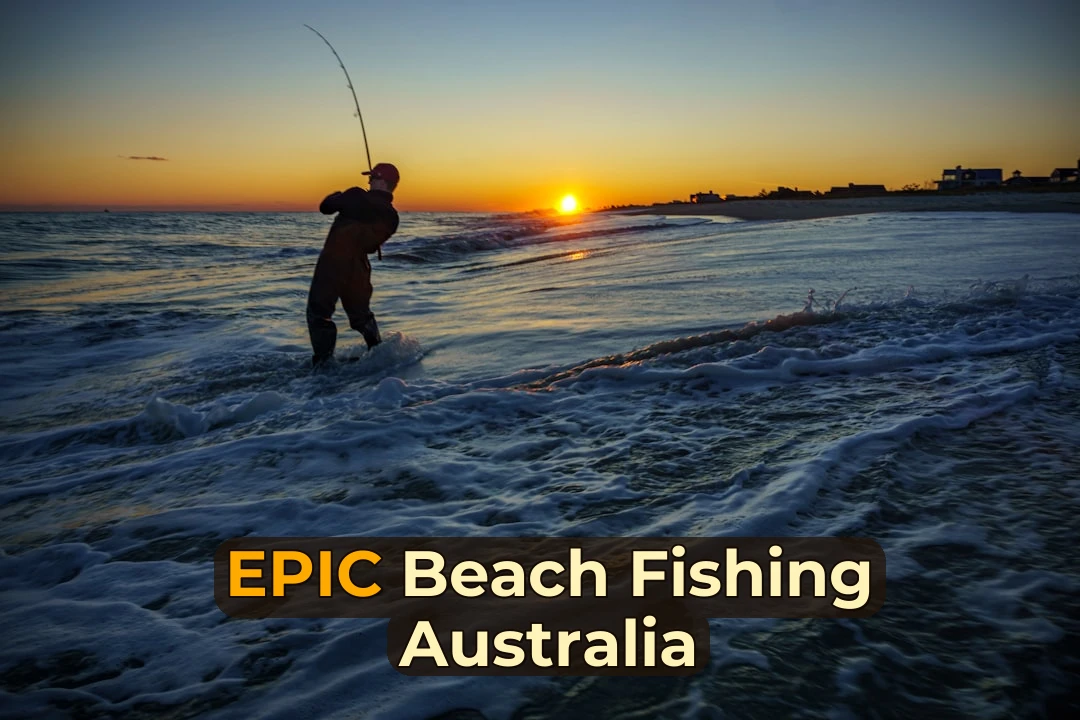
Have you ever stood knee-deep in churning surf, feeling the ocean pull at your ankles with every receding wave, while trying to cast a line into a moving target that changes shape every ten seconds?
If you have, you know the fundamental truth of beach fishing in Australia: it is not a static hobby. It is a chaotic, dynamic interaction with one of the planet’s most powerful ecosystems. The romanticised notion of sitting on a towel, waiting passively for a bite, is a fantasy that quickly dissipates when the tide turns. Beach fishing demands that you become an active participant, reading the water’s rhythm and anticipating the movements of saltwater predators. This guide is not about luck; it is about mechanics, observation, and the relentless pursuit of understanding the marine environment that surrounds our vast continent.
From the turbulent, fish-rich waters of the Southern Ocean to the warmer, coral-fringed waters of the Coral Sea, Australian beaches offer some of the most diverse fishing opportunities on Earth. But accessing them requires more than just casting a line into the surf. It requires decoding hydrodynamics, selecting the correct gear matrix for specific conditions, understanding local bait ecology, and respecting the inherent dangers of the shoreline. This definitive resource breaks down these complex variables into actionable strategies, empowering you to move from a passive observer to an intelligent operator on the coast.
Decoding the Hydrodynamics (The “Where”)
The single greatest mistake novice beach anglers make is casting blindly. They look at the water and see a uniform expanse of blue-grey, ignoring the complex topography beneath the surface. Fish do not swim in straight lines across open water; they follow structure. They follow movement. To catch fish from the beach, you must learn to see the underwater landscape as it shifts with every tide.
Your primary focus must be on identifying “traps”—areas where the water depth changes abruptly or where currents converge. These are the feeding lanes of the ocean.
Understanding Sandbars and Rips
Sandbars are submerged ridges of sand that form parallel to the shore. They are the highways for baitfish, which schools move along the bars in search of food. Predatory species like Tailor, Salmon, and Snapper follow these schools, holding just behind or below the bar where they can ambush prey.
- The Drop-off: Look for sudden changes in water colour. Darker patches often indicate deeper water or drop-offs off the ends of sandbars. This is where larger fish hold, waiting for bait to get swept over the edge.
- Rip Currents: While dangerous to swimmers, rips are life-giving to fish. They create a constant flow of nutrients and oxygen, attracting baitfish that linger in the turbulent water upstream. Target the edges of rips, not the centre.
- Gullies and Channels: Erosion channels cut through sandbars, creating deep-water shortcuts for fish moving along the coast. These are consistent hunting grounds that rarely change position significantly from day to day.
The Tide Phase: Incoming vs. Outgoing
The direction of the tide dictates which side of a sandbar the fish will hold on. This is not just anecdotal; it is hydrodynamic fact.
“Fish don’t care about the tide clock; they care about water movement and oxygen levels. But understanding how the tide moves water allows you to predict where they will be before they arrive.” – Australian Marine Biologist
The Incoming Tide (Flood): As water rises, it pushes baitfish and smaller species onto the flats. Predatory fish move up with them, holding just below the breaking waves or on the edges of drop-offs. This is often when the most active feeding occurs, particularly at dawn or dusk.
The Outgoing Tide (Ebb): As water recedes, it drains off the flats, carrying baitfish with it into deeper water. Predators follow this drain, holding on the seaward side of sandbars or near channel mouths. If you cast onto the flats during a strong outgoing tide, you are likely casting into empty water.
The Gear Matrix (The “What”)
Gone are the days when a single multi-purpose rod and a basic spinning reel could handle any beach fishing scenario. The Australian coastline presents variable conditions—from the gentle, shallow bays of Queensland to the heavy surf zones of Victoria and Western Australia. Your gear must match the target species and the specific beach conditions.
This is not about buying the most expensive gear; it is about buying the *right* gear for the environment you are entering. We categorise beach fishing gear into two primary matrices: Light Tackle for sheltered bays and Heavy Duty for exposed surf zones.
Scenario 1: Light Tackle (Sheltered Bays and Flats)
This scenario applies to fishing in calm, protected waters such as bays, estuaries, and northern Queensland reefs. The target species here are typically fast-moving, schooling fish like Tailor, Whiting, Salmon (in cooler months), and Bream.
- Rod: A medium-light spinning rod (2.1m – 2.7m) with a fast action. The length is crucial for casting distance into shallow water, while the fast action allows for precise hook sets.
- Reel: A size 2500-3000 spinning reel with a smooth drag system. Look for corrosion-resistant coatings, as saltwater will destroy cheap aluminium alloys within months.
- Line: 4-6kg braided line for sensitivity, spooled with a 10-12kg fluorocarbon leader. Fluorocarbon is invisible in clear, shallow water and resists abrasion from coral and rocks.
- Lures: Small spinning lures (5g-10g) and soft plastics that mimic prawns and small baitfish.
Scenario 2: Heavy Duty (Exposed Surf and Deep Water)
This scenario applies to fishing in heavy surf, strong currents, or when targeting large bottom-dwelling predators like Mulloway (Artedius quaggy), Snapper, and King George Whiting. The conditions are harsh, the fish are powerful, and the stakes for gear failure are high.
“The ocean is unforgiving of cheap gear. If your reel costs less than $50, it will fail in saltwater. It is not a matter of ‘if’, but ‘when’.”
- Rod: A medium-heavy to heavy surf rod (3.0m – 4.2m). These rods are designed to cast heavy sinkers (3oz-8oz) and absorb the shock of large fish running into strong currents.
- Reel: A size 4000-5000 saltwater-rated spinning reel or a conventional casting reel. Key features include sealed drag systems (to prevent sand and salt intrusion) and high retrieve speeds for quick line recovery.
- Line: 10-20kg braided line is essential for sensitivity and strength. Use a heavy fluorocarbon leader (15-30kg) to resist abrasion from rocks and coral.
- Sinkers: Non-slip sinker rigs or paternoster rigs to keep your bait off the bottom in strong currents, allowing it to drift naturally.
The Unforgivable Mistake: Ignoring Corrosion
The most common gear failure on Australian beaches is corrosion. Saltwater is a potent electrolyte that rapidly degrades metal components, especially in reels with exposed bearings and drag washers. Cheap, store-bought reels often lack the necessary seals and corrosion-resistant coatings.
The Bait Ecology (The “Why”)
Many anglers spend hundreds of dollars on imported, mass-produced lures that look impressive in a tackle shop but fail to mimic the natural diet of local species. This is a fundamental misunderstanding of beach fishing ecology. The most effective bait is often already present in the ecosystem, right beneath your feet.
Using locally sourced bait offers three distinct advantages:
- Familiarity: Local fish are accustomed to eating local prey. A sand hopper or a pilchard triggers an instinctive feeding response.
- Scent: Natural bait releases oils and scent trails that artificial lures cannot replicate, attracting fish from greater distances.
- Cost and Accessibility: Sourcing bait locally is cheaper and ensures you are not caught out by a lack of store-bought options.
Native Bait Sources
Different Australian coastlines offer different native bait options. Understanding what is available on your local beach is crucial.
- Sand Hoppers (Beach Fleas): Abundant on sandy beaches across Australia, especially after storms. These small crustaceans are a primary food source for Whiting and Bream. Collect them by shaking a mesh bag in the swash zone.
- Pilchards (Sardines): In southern waters, pilchards are king. They attract a wide variety of species, from Tailor to Snapper. Use whole pilchards or chunks for bottom fishing.
- Squid and Mullet: In warmer waters, squid and small mullet are highly effective bait for Mulloway and Snapper. These can often be purchased from local fish markets or harvested by crabbing.
- Prawns: Live or frozen prawns are versatile and effective for Bream, Black Bream, and Trevally. Use them on a paternoster rig to keep them off the bottom.
Local Advantage: The “Local Advantage” is not just about cost. It is about ecological accuracy. Fish in your local waters have evolved to eat what lives there. By using sand hoppers, pilchards, or squid, you are speaking the language of the local ecosystem. This increases your success rates significantly compared to using imported lures that mimic foreign species.
Safety and Ethics (The “How”)
Fishing from the beach is one of the most dangerous forms of recreational angling. The ocean is a powerful, unpredictable force that claims lives every year in Australia. Your passion for fishing must be balanced by a rigorous commitment to safety and sustainability.
Assessing Beach Safety
Before you cast your first line, assess the environment. Use this checklist:
- Check the Flags: Never fish between the red and yellow flags unless you are an experienced swimmer and have explicitly checked with lifeguards. These areas are patrolled for swimmers, not fishermen.
- Weather Report: Check the Bureau of Meteorology (BOM) forecast for wind speed, wave height, and tidal predictions. High winds can create dangerous cross-currents.
- Tide Times: Know when the tide is coming in and going out. A rising tide can trap you on a sandbar or against rocks.
- Rip Currents: Identify rips and avoid fishing too close to them. If you are swept into a rip, do not fight it; swim parallel to the shore until you are out of the current.
Shark Awareness
Australia is home to several species of sharks, including Great White and Tiger sharks. While shark attacks are rare, the risk is real. Do not fish in areas known for high shark activity, especially at dawn and dusk when sharks are most active.
Sustainable Catch Limits
Sustainability is not just a buzzword; it is a necessity for the future of Australian fisheries. Overfishing has depleted many species, and it is your responsibility to follow local regulations.
- Size Limits: Always check the minimum and maximum size limits for your target species. Release undersized fish immediately to allow them to grow and reproduce.
- Bag Limits: Respect the daily bag limits. Do not keep more than you can consume or share with friends and family.
- Catch and Release: For many species, catch and release is the best practice. Use circle hooks to reduce gut-hooking and handle fish with wet hands to protect their slime coat.
The “Lost” Fish Lesson: Early in my fishing career, I lost a massive Snapper to a poorly tied knot on soft sand. The hook had slipped out because I was using the wrong technique for sandy bottoms. This taught me that technical precision—whether it’s knot tying, hook setting, or gear selection—is just as important as finding the fish. A lost fish is a lesson in humility and a call to improve your skills.
The Golden Hour: A Temporal Revelation
There is a specific window of time each day that separates the average angler from the skilled one: The Golden Hour. This is not merely about good lighting; it is a biological trigger for fish behaviour.
The transition from dawn to daybreak is when the angle of the sun changes rapidly, illuminating submerged sandbars and structures that were invisible in the dark. This visual change often triggers a feeding frenzy among baitfish, which in turn attracts predatory species.
The “Golden Hour” Revelation: Arriving at your fishing spot 30 minutes before dawn allows you to watch the light hit the water. Observe where the breaking waves change colour as the sun rises. This is your map. Cast into these newly illuminated areas, and you will often find yourself in the middle of a feeding storm. This is not luck; it is observation applied to timing.
Conclusion: The Call to Observation
Beach fishing in Australia is not a simple pastime. It is a complex interaction with one of the most powerful and diverse ecosystems on Earth. It requires you to understand hydrodynamics, select appropriate gear for specific conditions, utilise local bait sources effectively, and prioritise safety and sustainability above all else.
The ocean does not care about your equipment budget or how many hours you’ve spent reading blogs. It responds only to those who listen to its rhythms. Your next cast isn’t just about catching a fish; it’s about understanding the water you stand in. Go to your local beach, watch the waves for an hour before you touch a rod, and ask yourself: where is the water hiding its secrets? That question is your first catch.
Key Takeaways:
- Decode the Water: Look for sandbars, rips, and drop-offs. Fish follow structure, not open water.
- Match Your Gear: Use light tackle for sheltered bays and heavy duty gear for exposed surf. Never compromise on corrosion resistance.
- Use Local Bait: Sand hoppers, pilchards, and squid are more effective than imported lures because they trigger instinctive feeding responses.
- Prioritise Safety: Check weather, tides, and rip currents. Never turn your back on the ocean.
- Fish Sustainably: Respect size and bag limits. Release undersized fish and handle them with care.
This resource is designed to be a living document, updated as new information becomes available. For specific fishing reports and local regulations, consult your state’s fisheries department website.
Frequently Asked Questions
What are the key underwater structures to target when beach fishing in Australia?
Novice anglers often cast blindly, but successful beach fishing requires identifying ‘traps’ where water depth changes abruptly. Focus on sandbars, which act as highways for baitfish; predatory species like Tailor and Snapper hold just behind or below them. Look for drop-offs indicated by darker water patches at the ends of sandbars, where larger fish ambush prey. Additionally, target the edges—not the centre—of rip currents, as they bring nutrients that attract baitfish. Gullies and erosion channels also serve as consistent deep-water shortcuts for fish moving along the coast, offering reliable hunting grounds.
How should I select gear for sheltered bays versus exposed surf zones?
Gear selection depends on water conditions and target species. For sheltered bays with calm waters, use light tackle: a medium-light spinning rod (2.1m–2.7m) with a size 2500-3000 reel, 4-6kg braided line, and a 10-12kg fluorocarbon leader. For exposed surf zones with heavy currents, switch to heavy-duty gear: a medium-heavy to heavy surf rod (3.0m–4.2m) paired with a size 4000-5000 saltwater-rated reel. Use 10-20kg braided line and heavy fluorocarbon leaders (15-30kg) to resist abrasion. Always rinse gear with fresh water after trips to prevent corrosion, which destroys cheap reels quickly.
When is the best time to fish from the beach for maximum activity?
The most active feeding often occurs during dawn or dusk, particularly during the ‘Golden Hour.’ This is 30 minutes before to after sunrise when sunlight illuminates submerged sandbars and structures that were previously invisible, triggering a feeding frenzy among baitfish. Additionally, tide phases dictate fish location: during an incoming (flood) tide, predators hold just below breaking waves or on drop-off edges as bait moves onto flats. During an outgoing (ebb) tide, fish move seaward to follow draining bait, so casting onto flats during strong ebb tides is likely ineffective.
What are the critical safety protocols and ethical practices for Australian beach fishing?
Safety is paramount; never turn your back on the ocean or fish alone in unfamiliar waters. Check Bureau of Meteorology forecasts for wind and wave height, identify rip currents, and avoid fishing between red and yellow flags unless experienced. If swept into a rip, swim parallel to shore. Ethically, respect local size and bag limits strictly. Use circle hooks to reduce gut-hooking and handle fish with wet hands to protect their slime coat. Prioritise catch and release for many species, ensuring undersized fish are released immediately to support sustainable fisheries.

Be the First to Comment
Sign in to start the conversation.