

The Light Calendar — When Australia Reveals Itself
Australian light behaves differently than anything photographers encounter in the Northern Hemisphere. The southern latitude creates elongated golden hours, particularly in the Blue Mountains where the sun tracks at angles that can either illuminate vast canyon systems or plunge them into deep shadow within minutes of change.
Understanding the Australian Light Dynamic
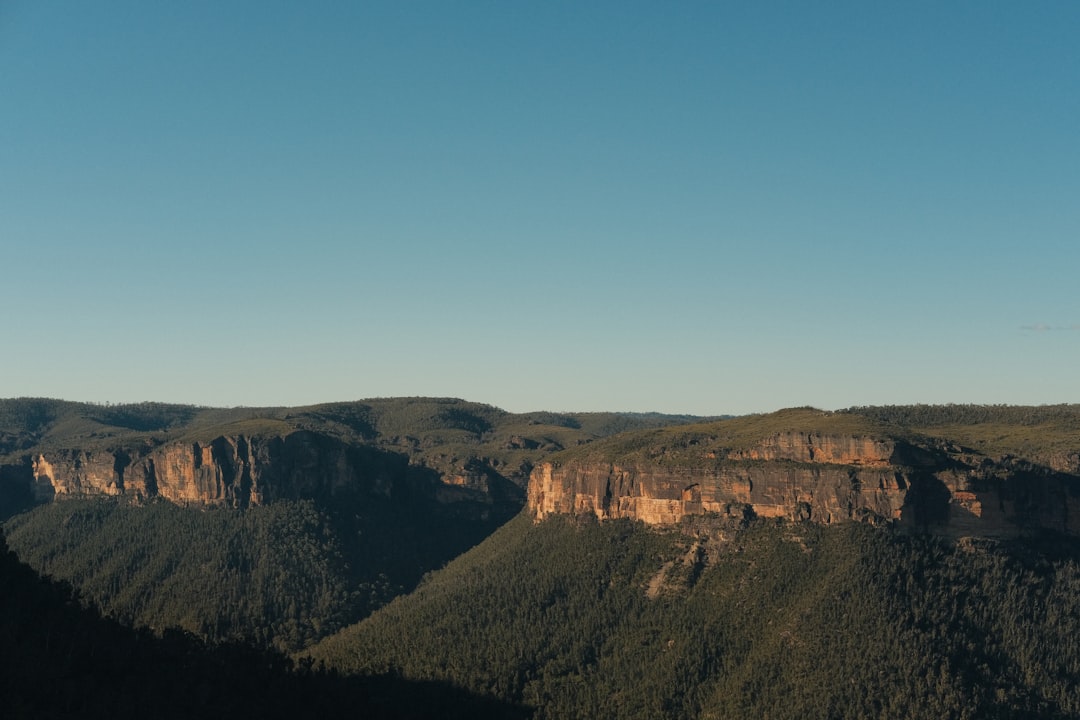
The Blue Mountains region experiences approximately 4.5 hours of optimal photography light during summer months (December through February) and roughly 3 hours during winter. However, these figures mislead more than they inform. The reality involves understanding how eucalyptus forests interact with atmospheric conditions to create the region’s namesake blue haze—a phenomenon that can enhance or destroy photographic opportunities depending on your objectives.
The famous blue tint occurs when eucalyptus oil vapour disperses short-wavelength light (blue spectrum) across vast distances. This creates ethereal, layered compositions at certain times and flat, washed-out images at others. The difference? Humidity, temperature, and time of day working in combination.
Month-by-Month Photography Conditions
January-February (High Summer): Harsh overhead light dominates midday hours, making canyon photography challenging. Dawn and dusk offer relief, with sunrise around 5:45am providing two hours of quality light. Wildflower season begins in late January, creating foreground opportunities at Wentworth Falls and Leura Cascades. Expect crowded viewpoints and limited parking at premium locations.
March-May (Autumn Prime): The sweet spot for Blue Mountains photography. Shorter days concentrate optimal light into manageable windows. Morning mist settles in valleys until 9am, creating depth and atmosphere. Autumn colour peaks in late April along the National Pass and around Mount Wilson. Waterfalls maintain strong flow from summer rains. This period delivers the most reliable conditions for the region’s signature blue haze effect.
June-August (Winter): Low sun angles create extended golden hours but also increase shadow coverage in east-facing canyon systems. Frost conditions overnight can produce exceptional morning imagery, particularly at Govetts Leap and Blackheath area lookouts. Waterfalls reach peak flow. Crowds diminish significantly. Pack thermal layers—temperatures regularly drop below zero before dawn.
September-November (Spring): Wildflower explosion transforms heathland areas into foreground paradises. Waratahs, boronias, and mountain devils create unique compositional opportunities unavailable other times of year. Weather becomes unpredictable—brilliant clear mornings can transition to complete whiteout by midday. Flexible itineraries essential.
Three Tiers of Blue Mountains Mastery
Photography locations in the Blue Mountains sort naturally by time investment rather than technical difficulty. This framework respects the reality that spectacular images require presence at optimal moments—not just showing up at convenient times.
Dawn Patrols: High Reward, Accessible Commitment
Wentworth Falls at First Light
GPS: -33.7324, 150.3694
Walking time: 25 minutes from parking to primary composition point
Best months: March-May, September-November
The National Pass track offers the region’s most dramatic accessible compositions. Arrive 45 minutes before official sunrise—the cliff face catches pre-dawn glow while the valley below remains shrouded in mist. The classic shot positions the falls as a leading line with layered ridges beyond, but consider the less obvious compositions: detail shots of fern fronds catching first light, or wide angles incorporating the walking track as a human element.
Echo Point Beyond the Lookout
GPS: -33.7317, 150.3119
Walking time: 10 minutes to main viewing platform, additional 15 minutes to Lady Darley Lookout
Best months: Year-round, but optimal in autumn and winter
Eight million annual visitors photograph the Three Sisters from the main platform. Most capture identical images. The photographer seeking unique work walks 800 metres along the Prince Henry Cliff Walk to Lady Darley Lookout, where the composition changes entirely—the Sisters appear in a different relationship to the valley, and foreground opportunities include native flora rather than paved surfaces.
For truly distinctive images, arrive before 5am and position yourself below the main lookout on the Gun emplacement (historic WWII installation). This vantage point offers dramatic upward compositions of the Three Sisters against pre-dawn colour, completely unavailable to photographers who arrive after first light.
The Day-Long Pursuits: Investment Required
Grand Canyon Track
GPS: -33.7178, 150.3572 (Evans Lookout start)
Walking time: 4-6 hours including photography stops
Best months: March-May, September-November
This 6-kilometre loop descends into the canyon system itself, offering intimate compositions unavailable from any lookout. The challenge: contrast management. Deep shadows and bright sky create extreme dynamic range that challenges even modern sensors. Plan for bracketed exposures or graduated neutral density filters.
The payoff includes unique perspectives of Greaves Creek, fern-lined walls reaching toward limited sky, and the opportunity to photograph the canyon from within rather than above. Water seepage on canyon walls creates perpetual moisture—protect your equipment with rain covers even on clear days.
Leura Cascades Circuit
GPS: -33.7156, 150.3345
Walking time: 3-4 hours including cliff walk extension
Best months: Year-round, optimal after rainfall
The cascades themselves offer classic waterfall photography, but the real prize lies along the Prince Henry Cliff Walk extension toward Gordon Falls. This section delivers intimate canyon views, multiple waterfall compositions, and the famous “amphitheatre” where Leura Falls Creek drops into a carved bowl. Long exposures work beautifully here—bring a 6-stop neutral density filter for the 2-4 second exposures that render water as silky threads.
The Overnight Missions: Maximum Commitment
Dumplings Pinnacle via Du Faur Head
GPS: -33.6278, 150.2834 (approximate, route requires navigation)
Walking time: 7-9 hours return with significant off-track navigation
Best months: April-May, September-October
This location rewards photographers willing to navigate unmarked routes through challenging terrain. The pinnacle offers perhaps the most dramatic foreground-background relationship in the entire Blue Mountains: weathered sandstone formations against the Grose Valley wilderness. Access requires research, offline maps, and honest self-assessment of navigation skills.
The photographic opportunity justifies the commitment. Sunrise from Dumplings Pinnacle delivers 270-degree valley views, with the blue haze effect at its most intense. Plan an overnight camp to avoid pre-dawn navigation—camping is permitted in the Grose Valley with appropriate booking through National Parks.
Cox’s River Access via Six Foot Track
GPS: -33.6589, 150.2012 (river crossing point)
Walking time: 6-8 hours return from Explorers Tree
Best months: March-May
The Six Foot Track descends from Katoomba through changing ecosystems to the Cox’s River, offering photographic diversity unavailable on shorter walks. The river crossing provides iconic images—long exposures of water flowing around boulders, reflections of surrounding forest, and the historic suspension bridge as a subject. Plan for an early start and full day commitment.
Equipment Reality Check — What Actually Matters
After years photographing the Blue Mountains across all seasons, certain gear choices have proven their value repeatedly while others gathered dust in the bag. This section strips away marketing noise to address what genuinely impacts image quality in this specific environment.
What I’ve Carried and Regretted
The 150-600mm telephoto seemed essential for wildlife opportunities. It wasn’t. The Blue Mountains rewards wide to moderate focal lengths (16-70mm full-frame equivalent) far more frequently. Wildlife appears, but typically at close range—wallabies at campgrounds, lyrebirds on walking tracks, rosellas at picnic areas. The heavy telephoto added fatigue without corresponding benefit.
Similarly, the dedicated macro lens saw limited use. While wildflower photography opportunities abound, the wind conditions in exposed locations make dedicated macro work frustrating. Better results came from extension tubes on standard zooms, allowing quick conversion between close-focus and landscape work without lens changes in dusty conditions.
Australian-Specific Equipment Considerations
UV Intensity: Australia’s UV levels exceed Northern Hemisphere equivalents at similar latitudes. Lens coatings degrade faster here. Use UV filters as protection—they’re cheaper to replace than front elements. More importantly, UV haze affects image clarity at distance. The high-quality UV filter (not cheap ones that introduce their own haze) actually improves telephoto landscape work here.
Dust Ingress: The Blue Mountains experiences periodic dust events, particularly in late summer and during drought conditions. Weather-sealed bodies and lenses prove their value here. If shooting with non-sealed equipment, avoid lens changes in the field. The fine dust penetrates focus rings and button seams, causing issues months later.
Leech-Proofing: Yes, leeches. They appear in damp gullies after rain, particularly along the Grand Canyon Track and in the Megalong Valley. They don’t damage equipment, but they distract enormously when crawling across hands during critical moments. Gaiters and insect repellent on lower trouser legs prevent most encounters. A small salt shaker in the first aid kit removes attached leeches quickly—never pull them off, as the mouthparts remain and cause infection.
Lens Recommendations by Location
- Wide canyon vistas (Echo Point, Govetts Leap): 16-35mm equivalent. The extreme width captures the layered ridge system while allowing foreground inclusion.
- Waterfall detail (Wentworth Falls, Leura Cascades): 24-70mm equivalent. Provides flexibility for both intimate detail and broader context.
- Canyon interiors (Grand Canyon Track): 16-35mm equivalent. Tight spaces demand wide angles, but avoid extreme wide-angle distortion on vertical elements.
- Wildflower work (spring heathland areas): 70-200mm equivalent. Compression isolates subjects against soft backgrounds, and the working distance avoids casting shadows on your subject.
The Unspoken Technical Skills
Australian landscape photography demands techniques rarely discussed in general photography education. The specific challenges of this environment—extreme contrast, unique colour palette, safety considerations near cliff systems—require targeted approaches.
Managing Extreme Dynamic Range in Eucalyptus Forests
Eucalyptus forests create contrast nightmares. Bright sky filters through foliage while the forest floor remains in deep shadow. The difference often exceeds 10 stops, beyond the recovery capability of even excellent sensors. Three approaches work:
Exposure Bracketing: Capture 3-5 frames at 1-2 stop intervals. Modern software blends these seamlessly. Shoot handheld if shutter speeds permit—the Blue Mountains light often changes too quickly for tripod repositioning between brackets. Use your camera’s fastest burst rate to minimise alignment issues.
Graduated Neutral Density Filters: Physical filters darken the sky portion of the frame during capture. This approach works beautifully when the horizon line is clear (lookout photography) but fails when trees breach the horizon. The hard-edge grad filter creates obvious dark bands across bright trunks—soft-edge grads transition more naturally.
Shadow Acceptance: Sometimes the most powerful compositions embrace deep shadow. Rather than fighting to reveal every detail, expose for the highlights and let shadows fall to black. This approach particularly suits the canyon photography where the interplay of light and darkness creates drama.
Focus Stacking for Hyper-Detail Bush Textures
The Blue Mountains offers extraordinary foreground textures: weathered sandstone, fern fronds, tree fern bark, wildflower details. Capturing these with both foreground sharpness and background context requires focus stacking—capturing multiple images at different focus points and blending in post-processing.
The technique demands a tripod and static subjects (wind makes stacking impossible with moving foliage). Set your aperture to f/8-f/11 for lens sharpness, then capture frames focusing progressively further into the scene. Most situations require 3-7 frames. Photoshop’s auto-align and auto-blend handles the merge efficiently.
The Humidity-Mist Balance
The ethereal Blue Mountains aesthetic—that layered, misty quality defining the region’s best imagery—requires specific conditions. Too much mist obscures the layered ridges entirely. Too little produces flat, lifeless images. The balance typically occurs when:
- Overnight temperatures dropped 8-10°C below the previous day’s maximum
- Humidity reached 85-95% overnight
- Morning warming begins but hasn’t cleared the valley mist
- Light breeze exists (complete stillness allows mist to settle into uniform fog)
This combination occurs most frequently in autumn, typically 20-40 minutes after official sunrise. The window closes within an hour as warming accelerates. Setting up in pre-dawn darkness ensures readiness when conditions align.
Safety Protocols for Cliff Edge Photography
Specific location hazards to understand:
- Govetts Leap: The main lookout is safe, but photographers venturing along unfenced sections of the cliff top face significant exposure. The rock face continues undercut beyond the visible edge.
- Wentworth Falls: The top of the falls presents slippery rock surfaces. Multiple fatal accidents have occurred when visitors approached the water’s edge. Stay on formed tracks and viewing platforms.
- Grand Canyon Track: The canyon floor is safe, but rock falls occasionally occur. Avoid lingering directly beneath large overhangs, particularly after heavy rain.
Practical protocol: Shoot with a partner when working near cliff edges. If shooting alone, text your location and expected return time to someone before departing. Carry a PLB (Personal Locator Beacon) on overnight or remote location shoots—mobile coverage is unreliable in canyon systems.
Post-Processing the Australian Palette
Australian landscapes present unique colour challenges. The familiar blue-green of eucalyptus, the saturated orange-red of sandstone, the particular quality of Australian light—these require targeted processing approaches rather than generic landscape presets.
The Eucalyptus Challenge
Eucalyptus foliage presents as blue-grey-green, a combination that confuses colour processing algorithms designed for Northern Hemisphere vegetation. Automatic white balance often over-corrects, neutralising the blue cast that actually exists in the scene. The result: images that feel accurate but look wrong.
Solution: Set white balance manually in post-processing. Begin with the daylight preset (approximately 5500K), then adjust by eye while referencing the eucalyptus foliage. The blue-grey should remain visible—it’s real, not a colour cast to remove. Typically, this means leaving slightly more blue in the shadows than feels intuitive.
Sandstone Saturation
Blue Mountains sandstone ranges from cream through orange to deep red, often within a single frame. This colour variation creates natural interest but can appear artificial if over-saturated. The temptation exists to push vibrancy on the orange tones—resist it.
Instead, use HSL (Hue-Saturation-Luminance) adjustments to target specific colour ranges. Boost luminance on orange while keeping saturation moderate. This reveals detail in the sandstone texture without the oversaturated appearance that signals heavy processing.
Specific Starting Points (Lightroom/Capture One)
These values provide starting points for Blue Mountains imagery—adjust to taste and specific conditions:
- Exposure: Set to place highlights just below
Frequently Asked Questions
When is the best time of year to photograph the Blue Mountains’ famous blue haze effect?
The blue haze effect is most intense during autumn (March to May), when morning humidity levels hover between 70-85% and temperatures range 12-18°C. These optimal conditions typically occur between 6:15am and 8:30am. The phenomenon occurs when eucalyptus oil vapour disperses short-wavelength blue light across vast distances, creating ethereal layered compositions. March-May also delivers the most reliable conditions overall, with an average of 7 clear or partly cloudy days per fortnight and morning mist settling in valleys until 9am.
What camera equipment is actually essential for Blue Mountains photography?
Wide to moderate focal lengths (16-70mm full-frame equivalent) are far more useful than telephoto lenses in the Blue Mountains. A high-quality UV filter is essential as Australia’s UV levels degrade lens coatings faster than Northern Hemisphere equivalents. A polarising filter proves more valuable than any other accessory for waterfall photography, cutting glare from wet sandstone and foliage. For waterfall shots at Leura Cascades, bring a 6-stop neutral density filter for 2-4 second exposures. Weather-sealed equipment is important as fine dust penetrates non-sealed gear during periodic dust events.
How do you manage the extreme contrast when photographing eucalyptus forests?
Eucalyptus forests create contrast differences often exceeding 10 stops. Three effective approaches work: exposure bracketing (capture 3-5 frames at 1-2 stop intervals for software blending), graduated neutral density filters (use soft-edge grads as hard-edge filters create dark bands across bright tree trunks), or shadow acceptance where you expose for highlights and let shadows fall to black. For handheld bracketing, use your camera’s fastest burst rate to minimise alignment issues as Blue Mountains light changes too quickly for tripod repositioning between brackets.
What are the most rewarding photography locations in the Blue Mountains for different time commitments?
For dawn patrols, Wentworth Falls (GPS: -33.7324, 150.3694) offers dramatic compositions with a 25-minute walk, best visited 45 minutes before sunrise. Echo Point’s Lady Darley Lookout (800m along Prince Henry Cliff Walk) provides unique Three Sisters compositions away from crowds. For day-long pursuits, the Grand Canyon Track (6km loop, 4-6 hours) offers intimate canyon perspectives, whilst Leura Cascades Circuit (3-4 hours) delivers waterfall photography. For maximum commitment, Dumplings Pinnacle requires 7-9 hours return with off-track navigation but rewards with 270-degree valley views and intense blue haze effects at sunrise.
How much should I budget for Blue Mountains photography equipment to get quality results?
You don’t need $4,000 in glass to capture extraordinary Blue Mountains images. The iconic Three Sisters has been captured brilliantly on everything from smartphones to medium format systems. The investment that actually matters is time, patience, and understanding of light conditions. A $1,500 lens at the right moment outperforms a $4,000 lens at the wrong one. Focus your budget on practical accessories: quality UV filters for lens protection, a polarising filter for waterfall work, and weather-sealed bodies if possible. Extension tubes on standard zooms offer flexibility for wildflower photography without dedicated macro lens expense.


Be the First to Comment
Sign in to start the conversation.